
Robert Fairman


Exploring minimalism through the language of classical painting,
Horizon employs the defining element common to landscape traditions - the horizon. Reducing the compositions to their most fundamental structure - the relationship between the divide.
These restrained compositions are presented in selected antique frames which function
as architectural boundaries, anchoring the works within an art-historical tradition, allowing contemporary abstraction to exist in conversation with the past.

Triptych is based on Three Studies for Figures at the Base of a Crucifixion (1944) by Francis Bacon, this work seeks to preserve the essential visual identity through reduction. The dominant colour from each painting has been isolated and translated into three subtly different fields of orange.
Bacon's figurative imagery has been removed entirely, yet the triptych remains immediately recognisable through its proportions, chromatic relationships and overall structure. The work asks how little can remain before an image loses its identity, suggesting that memory, colour and composition can be as powerful as representation itself.
Installations

The following are site-specific installations that respond to the available, anonymous and forgotten areas: blank walls, sealed alcoves and architectural voids, revealing their latent presence through subtle intervention.
Hazard occupied an external anonymous wall marked by layers of graffiti, peeling paint and years of accumulated wear. Four vertical panels, alternating black and yellow, sealed an inaccessible recess within the wall, transforming a redundant architectural opening into a symbolic warning.


Quadrant occupied interior and exterior zones within this building. Externally, the installation enclosed a distressed former access point using a muslin-skinned four-part structure. Internally, an identical structure sealed the facility's general notice board beneath a latex membrane.
The translucent materials transformed the familiar architectural history which remained visible through the materials. The work transformed the functional spaces into quiet records of occupation, where the ordinary became abstract and the familiar was experienced anew through the filtering of light and material.

Intramural installed within a north London art school, transforming the public hallway into the symbolic heart of the building, exploring the idea of the building as a living body.
The structure skinned in red latex rubber enclosed a second suspended core frame illuminating and pulsing with light referencing the rhythm of a heartbeat. The latex released a distinctive scent under the light, introducing an unexpected sensory dimension reinforcing the work's sense of physical presence. Intramural invited viewers to experience the familiar, anonymous hallway as something alive.

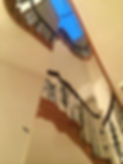

You installation occupied the totality of Arthouse1 gallery's vertical spine, a two-sided mirror sheet running the 10 metre height of the staircase within this listed Georgian building.
The installation encouraged visitors to reconsider their relationship to the building, to movement, and to their own presence, witnessing fragmented and constantly shifting reflections as they ascended and descended to the gallery. The mirror surface distorting the architecture and viewer's own image to create moments of uncertainty and heightened self-awareness, transforming a transitional space into an immersive optical experience,
Life Drawings




Paintings


